
Most sellers launch first and brand later. They list the product, run some ads, wait for the reviews to build, and plan to “sort out the branding” once revenue arrives. By then, they have already made hundreds of decisions — product titles, images, description copy, packaging, pricing — without a brand framework. Undoing those decisions is harder than making them right the first time.
Brand identity is not something you add after launch. It is the foundation that every launch decision should be built on.
What a D2C brand identity actually consists of
Brand identity for a D2C seller on Flipkart or Amazon is not a logo and a colour. It is a system of connected decisions that determine how your brand looks, sounds, and behaves across packaging, listings, ads, and customer communication.
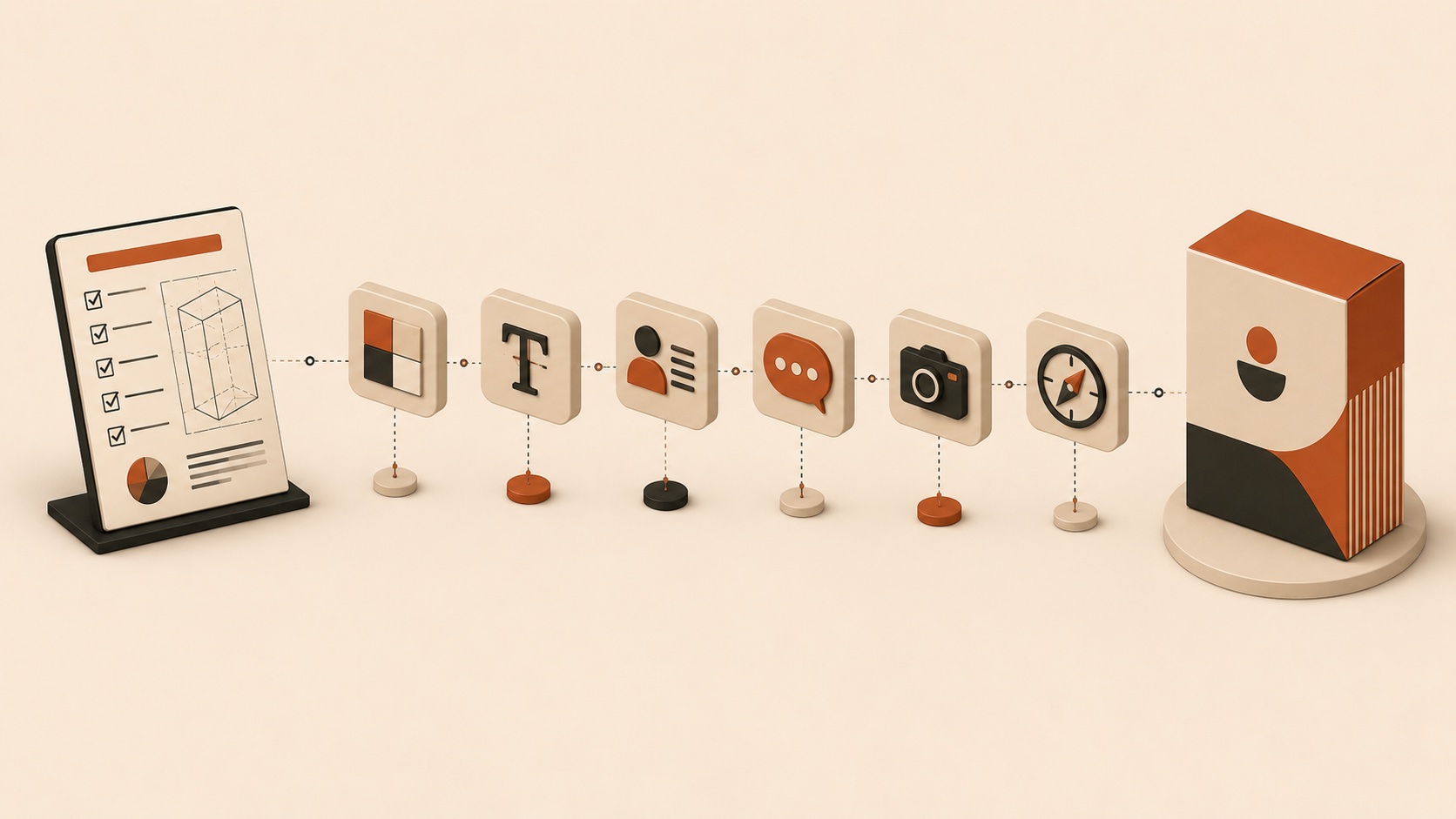
The system has six components. You need all six before you launch — not because of some branding principle, but because each one directly affects a launch decision you will have to make anyway.
Brand positioning. Who specifically you are for and what specifically you do differently. This determines your category strategy, your price point, and which keywords you target. Launching without a positioning statement means your category and keyword decisions are made by intuition rather than strategy.
Customer persona. A detailed profile of your most valuable buyer — not age and income, but psychology. What does she care about? What is she suspicious of? What language does she use to describe her problem? This persona determines your listing copy, your ad creative, and your packaging hierarchy. Every word you write for your listing should be written for this person.
Tone of voice. How your brand speaks. Clinical and expert, or warm and approachable? Direct and confident, or encouraging and gentle? This decision determines your product title structure, your bullet point style, your A+ content voice, and your packaging copy. Inconsistency here is what makes a brand feel like a catalogue, not a company.
Colour palette. Your primary, secondary, and accent colours with hex codes. This determines your packaging, your product image backgrounds, your Brand Store design, and your ad creatives. Launching with “we will figure out colours later” means your first 500 units of packaging will not match your Brand Store which will not match your Instagram. Rebuilding this after launch is expensive.
Typography. Your display font and body font. This affects your packaging, your A+ content module design, and any branded creative. It is a small decision with a large cumulative effect on whether your brand looks considered or generic.
Brand imagery direction. The style, mood, and subject matter of your product photography and lifestyle images. Marketplace algorithms favour images with high click-through rates. High click-through rates come from images that speak clearly to a specific buyer — not generic white-background product shots that look identical to every competitor.
The order that works
Build in this sequence. Each step informs the next.
Start with positioning. You cannot define your customer persona until you know what position you are taking in the market. You cannot write a tone of voice until you know who you are speaking to. You cannot brief a photographer until you know what mood and aspiration you are selling.
Positioning first. Persona second. Tone of voice third. Visual identity — colour, typography, imagery — fourth. Everything else follows from these four.
Most sellers do this in reverse. They choose colours because they like them, photograph products before they have a visual direction, and write listing copy before they have a tone of voice. The result is a launch that looks assembled, not designed.
What happens when you launch without brand identity
The Flipkart and Amazon algorithms are not neutral. They reward products with high click-through rates, high conversion rates, and low return rates. All three of these metrics are influenced by brand identity.
High click-through rate comes from a main image that speaks specifically to a buyer — which requires knowing who the buyer is and what visual language resonates with them. Generic images have generic click-through rates.
High conversion rate comes from listing copy that addresses specific concerns in a consistent, trustworthy voice — which requires a tone of voice guide and a customer persona. Generic copy converts generically.
Low return rate comes from accurate expectation setting — packaging, listing copy, and product imagery that all promise the same thing and deliver it. When brand identity is inconsistent, expectation setting is inconsistent, and return rates reflect that.
Sellers who launch without brand identity spend their first six months trying to fix metrics that could have been strong from day one.
How long this actually takes
A brand agency will take four to eight weeks and charge ₹1 to ₹5 lakh to produce the brand identity assets described above. For a seller preparing to launch, this timeline and budget is often impossible.
thebrandlanguage generates a complete brand identity document — positioning statement, customer personas, tone of voice guide, colour palette, typography direction, and imagery guidelines — in four minutes from your website URL or product description. The document is shareable, so your packaging designer, your listing copywriter, and your photographer all work from the same brief.
For a seller preparing to launch on Flipkart or Amazon, this is the fastest path from “we have a product” to “we have a brand ready to launch.”
Build your brand identity before you launch. Create yours free → Four minutes. Everything your designer, copywriter, and photographer need in one document.
Leave a Reply