
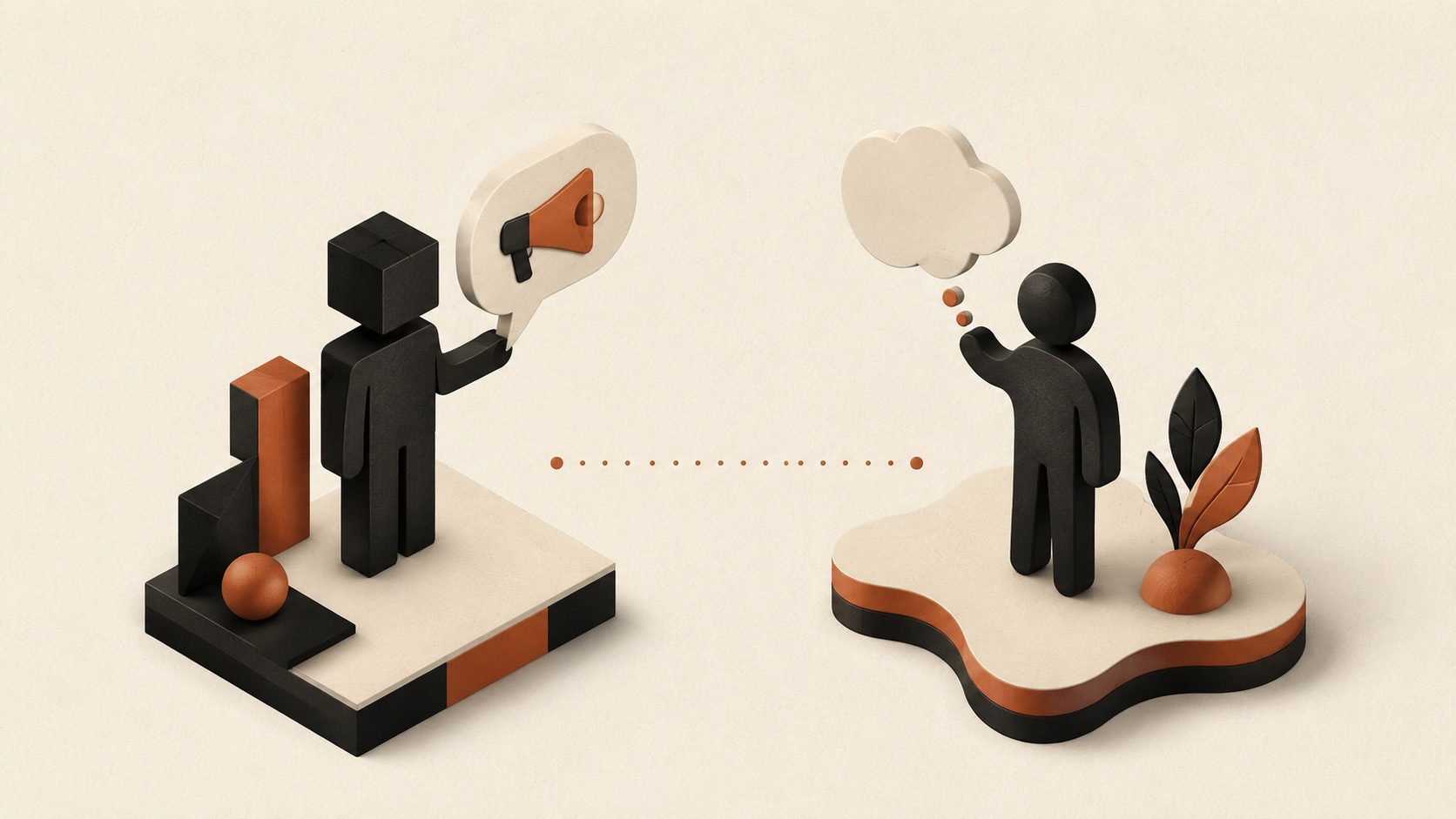
Most brand briefs confuse these two things. A brand persona is the character your brand projects — how it speaks, what it stands for, how it behaves. A customer persona is the character of your ideal buyer — who they are, what they want, what stops them from buying.
They are not the same. They are not interchangeable. And conflating them is why most marketing sounds like a brand talking to itself.
| Aspect | Brand Persona | Customer Persona |
|---|---|---|
| Definition | The character your brand embodies — its personality, voice, and values | A profile of your ideal customer — their goals, frustrations, and behaviour |
| Represents | The brand itself — how it shows up in the world | The buyer — how they think, feel, and decide |
| Created by | Brand strategists — based on brand values and positioning | Marketers — based on research, interviews, and data |
| Used for | Writing copy, designing visuals, setting communication guidelines | Targeting campaigns, shaping product decisions, writing messaging |
| Changes when | The brand repositions or evolves its identity | The target market shifts or new segments emerge |
| Example | “We are the direct, no-jargon expert in our category” | “Priya, 34, founder scaling a D2C brand without an agency” |
Why brands confuse them — and what goes wrong
The confusion usually starts with a well-intentioned brief. Someone asks “who is our brand?” and “who is our customer?” in the same meeting. The answers get written next to each other, and suddenly the brand persona starts picking up customer attributes — aspirations, pain points, demographic details — that have nothing to do with how the brand should sound.
The result: a tone of voice that reads like a target market description, not a brand character. Copy that says “we understand you’re a busy founder juggling ten priorities” instead of copy that demonstrates authority, warmth, or precision. Marketing that describes the customer back to themselves rather than offering them something distinctive.
They must be designed together — not in isolation
The relationship between a brand persona and a customer persona is where the real strategy lives. Your brand persona should be designed to resonate with your customer persona — but they are not the same document, and they should not be confused.
A useful test: read your brand persona out loud. Does it sound like a person with a distinct point of view? Or does it sound like a description of your customer? If it is the latter, you have written a customer persona and called it a brand.
The best brand personas have tension with the customer persona. The brand knows something the customer does not yet know. The brand has a perspective the customer finds clarifying. That gap — between what the brand stands for and what the customer currently believes — is where good marketing lives.
How to define both — without conflating them
Start with the brand persona. Define the character independent of who the customer is. What does this brand believe? How does it speak? What does it refuse to do? What would it sound like at a dinner party?
Then build the customer persona. Who is this brand trying to reach? What do they want? What is stopping them? What language do they use when they describe their problem?
Finally, stress-test the fit. Does the brand persona speak in a way that would resonate with this customer? Is the character credible given what the customer values? Are there any direct contradictions?
This sequence matters. If you start with the customer persona and build the brand persona to match, you end up with a brand that mirrors its audience instead of leading them.
What this looks like in practice
A D2C skincare brand might have a brand persona that is precise, science-grounded, and quietly confident — it does not oversell, it educates. Its customer persona might be a 28-year-old woman who is overwhelmed by marketing claims and distrustful of before-and-after photos.
The brand persona does not mirror that distrust — it addresses it. It speaks with the kind of calm authority that earns trust rather than demanding it. The gap between “I am sceptical of beauty marketing” and “this brand actually explains the ingredient science” is the marketing opportunity.
That alignment — not sameness — is what both documents are for.
Brand personas and AI visibility in 2026
There is a newer reason this distinction matters. AI tools like ChatGPT, Perplexity, and Gemini now recommend brands in response to category queries. They do this by drawing on consistent, well-defined brand signals across the web — schema data, named entity mentions, brand description consistency.
A brand persona gives AI systems the consistent character signal they need to classify and reference your brand accurately. A customer persona is irrelevant to this process — AI does not need to know who your customer is, it needs to know what your brand is.
Brands that cannot describe themselves consistently — because their brand persona is either undefined or confused with their customer persona — are harder for AI systems to recognise as distinct entities. The result is less AI citation, less recommendation, less visibility in AI-powered search.
Both in four minutes
thebrandlanguage generates both a brand persona and customer personas in the same document — designed together so they are complementary, not competing. The brand persona defines how the brand speaks and what it stands for. The customer personas define who it is speaking to and what they need to hear.
Ready to define both for your brand? Create your brand language free → Four minutes. One link. Brand persona and customer personas — built together.
Leave a Reply