
Your rebrand launch is six months away. You’re excited about the new direction. But right now, you’re staring at a messy pile of tasks with no clear starting point.
A successful rebrand needs structure. Miss one step and you’ll face confused customers, inconsistent messaging, or worse — a brand that falls flat on launch day.
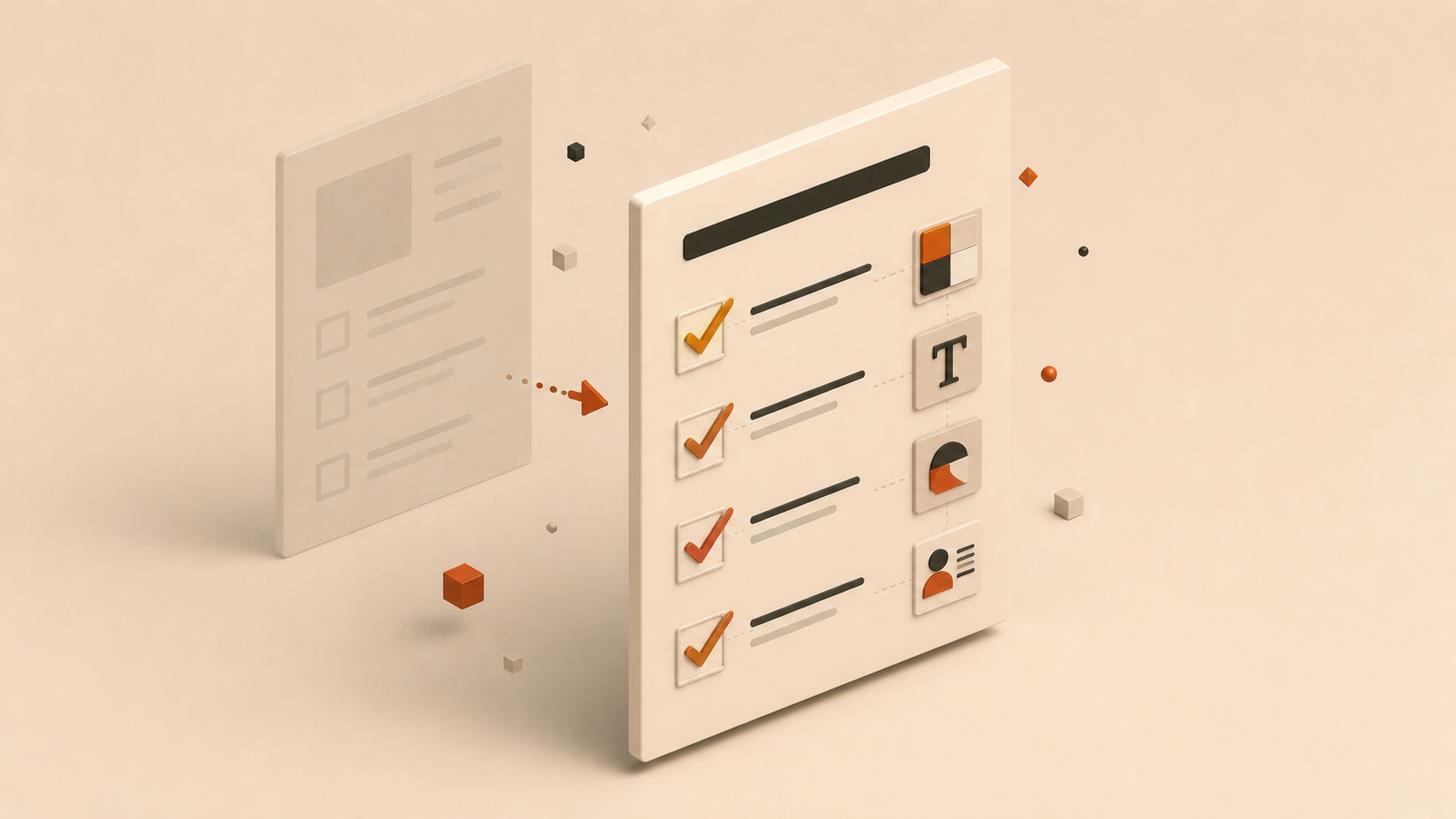
This rebranding checklist breaks down everything you need to plan, execute, and protect your new brand identity.
Research and strategy foundation
Start with research. Your rebrand should solve real problems, not create new ones.
Conduct customer interviews. Ask why they chose you. What do they value most? What frustrates them? Document their exact words — you’ll use this language later.
Analyze your competitors. Map their positioning, visual style, and messaging. Find the gaps where your brand can stand out.
Define your brand strategy clearly:
- Brand purpose — why you exist beyond profit
- Brand values — what you stand for
- Brand personality — how you want to feel to customers
- Positioning statement — what makes you different
- Target audience — who you serve best
Write this down. Every design and messaging decision flows from these strategic foundations.
Visual identity development
Your visual identity makes the first impression. Get this wrong and customers won’t stick around to learn about your great strategy.
Start with your logo. Design multiple concepts. Test them at different sizes. Your logo needs to work on business cards and billboards.
Choose your color palette carefully. Colors trigger emotions. Blue builds trust. Red creates urgency. Green suggests growth. Pick colors that match your brand personality.
Select typography that supports your message. Clean fonts feel modern. Script fonts feel personal. Bold fonts feel confident. Your font choice speaks before anyone reads a word.
Create supporting visual elements:
- Icons and illustrations
- Photography style
- Graphic patterns
- Layout principles
Document everything in comprehensive brand guidelines. Your team needs clear rules to maintain visual consistency.
Messaging and content strategy
Your words matter as much as your visuals. Develop a voice that matches your personality and resonates with your audience.
Define your tone of voice. Are you friendly or professional? Casual or formal? Playful or serious? Create a spectrum for different situations.
Write your key messages:
- Value proposition — the main benefit you deliver
- Elevator pitch — your story in 30 seconds
- Tagline — your memorable catchphrase
- Mission statement — your purpose
Develop content templates for common situations. Email signatures, social media posts, customer service responses. Templates ensure consistent messaging across all touchpoints.
Create customer personas. Give them names, ages, challenges, and goals. Write like you’re talking to Sarah the startup founder, not “decision makers aged 25-45.”
Implementation timeline and asset creation
Plan your rollout carefully. You can’t change everything overnight without confusing customers.
Create your priority list:
- Website and digital presence
- Business cards and stationery
- Marketing materials
- Signage and physical spaces
- Product packaging
- Vehicle graphics
Set realistic timelines. Website redesigns take 2-3 months. Print materials need 2-4 weeks. Digital updates happen faster but still need coordination.
Build your asset library. Collect all logo variations, fonts, images, and templates in one shared location. Your team needs easy access to current brand assets.
Plan your launch sequence. Update your website first — it’s your primary brand touchpoint. Follow with social media, then print materials, then physical spaces.
Team alignment and training
Your rebrand only works if your team embraces it. Internal buy-in comes before external success.
Share the strategy behind your rebrand. Explain the research. Show how the new brand solves real problems. People support what they help create.
Train your team on the new brand:
- Sales team — how to present the new positioning
- Customer service — how to use the new tone of voice
- Marketing team — how to apply visual guidelines
- Leadership — how to embody brand values
Create quick reference guides. A brand consistency guide helps team members make brand-aligned decisions quickly.
Set up approval processes. Who reviews marketing materials? Who approves partnerships? Clear processes prevent brand dilution.
Launch preparation and measurement
Your launch moment matters. Prepare your announcement strategy carefully.
Write your rebrand story. Why did you change? What does it mean for customers? How does it improve their experience? Make it about them, not you.
Plan your communication channels:
- Email announcement to existing customers
- Social media campaign
- Press release
- Website banner
- Staff talking points
Prepare for questions. Customers will wonder if you’re the same company. Have clear answers ready.
Set success metrics. Brand awareness surveys. Website engagement rates. Customer feedback scores. Social media mentions. Sales performance. Measure what matters.
Tools like thebrandlanguage can help you create consistent brand guidelines quickly, giving you a solid foundation for your rebrand rollout.
Plan your post-launch review. Schedule check-ins at 30, 60, and 90 days. What’s working? What needs adjustment? Rebrands evolve based on real-world feedback.
Your rebrand checklist keeps you organized and accountable. Follow these steps and you’ll launch with confidence, not chaos.
Ready to create your brand language? Create yours free → Four minutes. One link. Everyone on the same page.
Leave a Reply